
Privacy-First Disposable Email Provider: What It Really Means in 2026
A privacy-first disposable email provider focuses on minimizing data collection, limiting message retention, and helping users avoid unnecessary tracking. As privacy awareness grows in 2026, many people are looking beyond basic temp mail features and asking how their data is actually handled.
This article explains what privacy-first really means for disposable email, how it differs from basic services, and what to expect when using temp mail responsibly.
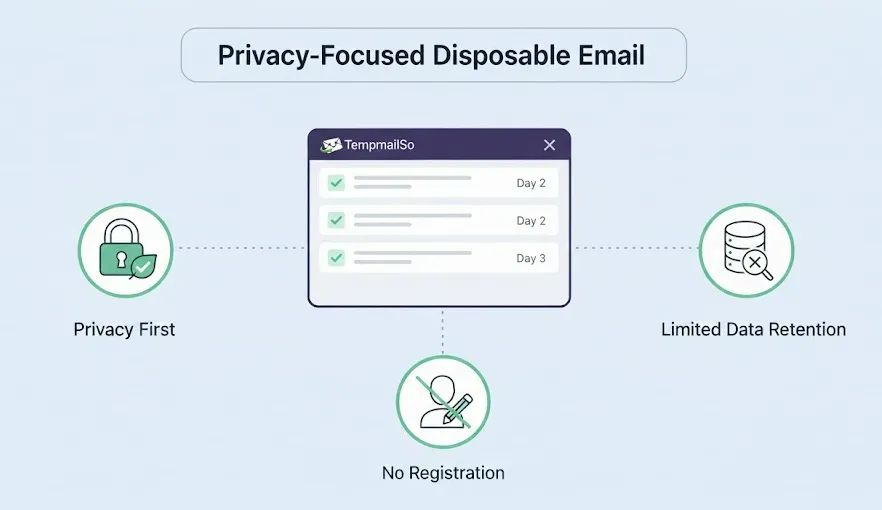
What does privacy-first mean for disposable email?
Privacy-first does not mean complete anonymity. It means the service is designed to reduce data exposure as much as possible.
Key principles usually include:
- No account registration required
- No long-term storage of messages
- Limited analytics for service stability
- Clear usage boundaries
This approach aligns with how temporary email is intended to be used.
How disposable email protects your real inbox
Using a disposable email separates short-term activity from your personal inbox. This reduces spam, marketing emails, and the chance of your real email being reused across multiple services.
Common benefits include:
- Fewer marketing emails
- Lower risk of email leaks
- Cleaner personal inbox
This is why disposable email is often used as a burner email for online registration.
Message retention and automatic deletion
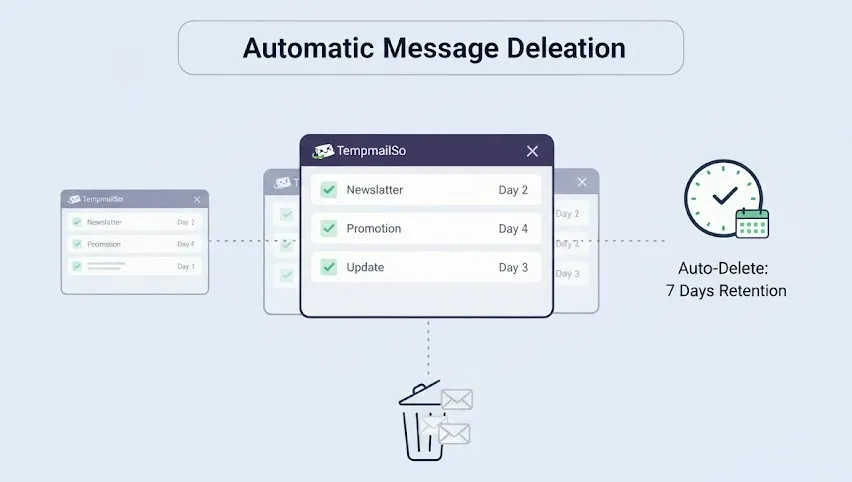
A privacy-first provider limits how long messages are stored. Automatic deletion reduces long-term exposure if data is accessed unintentionally.
Retention models vary, but the idea is the same: messages are not kept forever.
This balance between availability and privacy is also discussed when comparing how long a temporary email lasts.
No ads and reduced tracking
Advertising networks often rely on tracking scripts. A privacy-first disposable email provider typically avoids aggressive advertising to reduce tracking and data sharing.
An ad-free experience also improves usability and reduces the number of third-party requests.
Inbox reuse without long-term storage
Some privacy-focused services allow inbox reuse. This means you can access the same address again, even though older messages may be deleted.
Inbox reuse is helpful when verification emails are delayed or when you need short-term follow-up access.
On TempmailSo, inboxes can be reused, while all messages are deleted after 30 days.
Sharing inbox access carefully
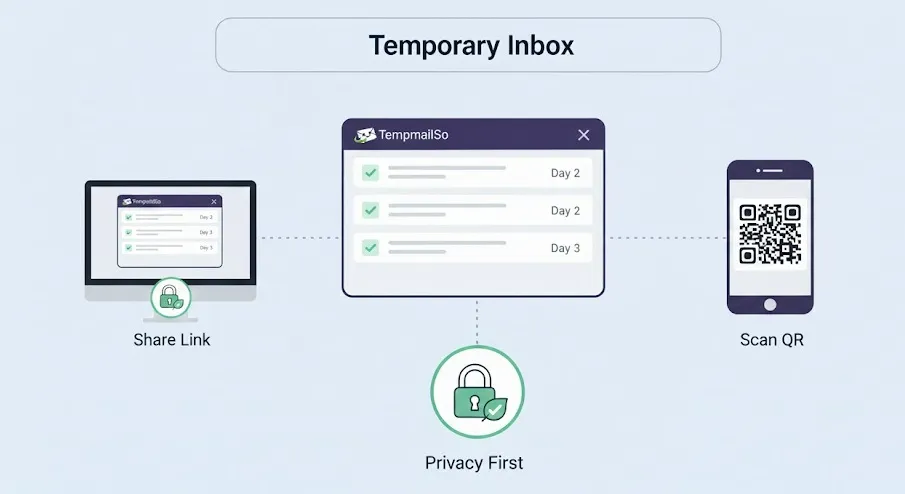
Privacy-first does not mean blocking convenience features. Sharing inbox access via a link or QR code allows verification across devices without creating accounts.
Because anyone with the link can access the inbox, sharing should only be used for low-risk situations.
What privacy-first disposable email does NOT protect
It is important to understand the limits. Disposable email reduces email-based exposure, but it does not hide everything.
- Websites can still track IP addresses and sessions
- Browser fingerprints may still identify devices
- Some platforms require phone verification
Privacy-first email should be used as part of a broader privacy approach, not as a complete solution.
When privacy-first disposable email is the right choice
This approach works best for:
- Short-term signups
- Newsletter access
- Testing and QA workflows
- Secondary or temporary accounts
For sensitive or long-term accounts, a regular email address remains the safer option. This distinction is closely related to whether temporary email is safe for a specific use case.
Frequently asked questions
Is privacy-first disposable email anonymous?
It reduces data exposure, but it does not guarantee full anonymity.
Does ad-free mean no tracking at all?
No. Limited analytics may still be used to keep the service stable and secure.
Can privacy-first temp mail be reused?
Often yes. The inbox address may be reused, but older messages may no longer exist.
Is privacy-first disposable email legal?
Yes, when used for lawful purposes and in accordance with website terms.
When used responsibly, it offers a practical balance between convenience and privacy. Acceptable use and limitations are described in the Disclaimer.